A pay range answers a different question from “What cash will I have available during my first month?” The first describes compensation information in a job advertisement. The second depends on your actual terms, hours or salary arrangement, start date, payroll timing, withholding and deductions. Turning the highest number in a listing into a household budget skips nearly all of that work.
Use the official Nordstrom careers site for current role-specific advertisements. This article does not reproduce a wage range or assume one compensation arrangement across the company. Listings change, and an advertisement for another location or role cannot establish the terms of your own offer.
Keep three kinds of number separate
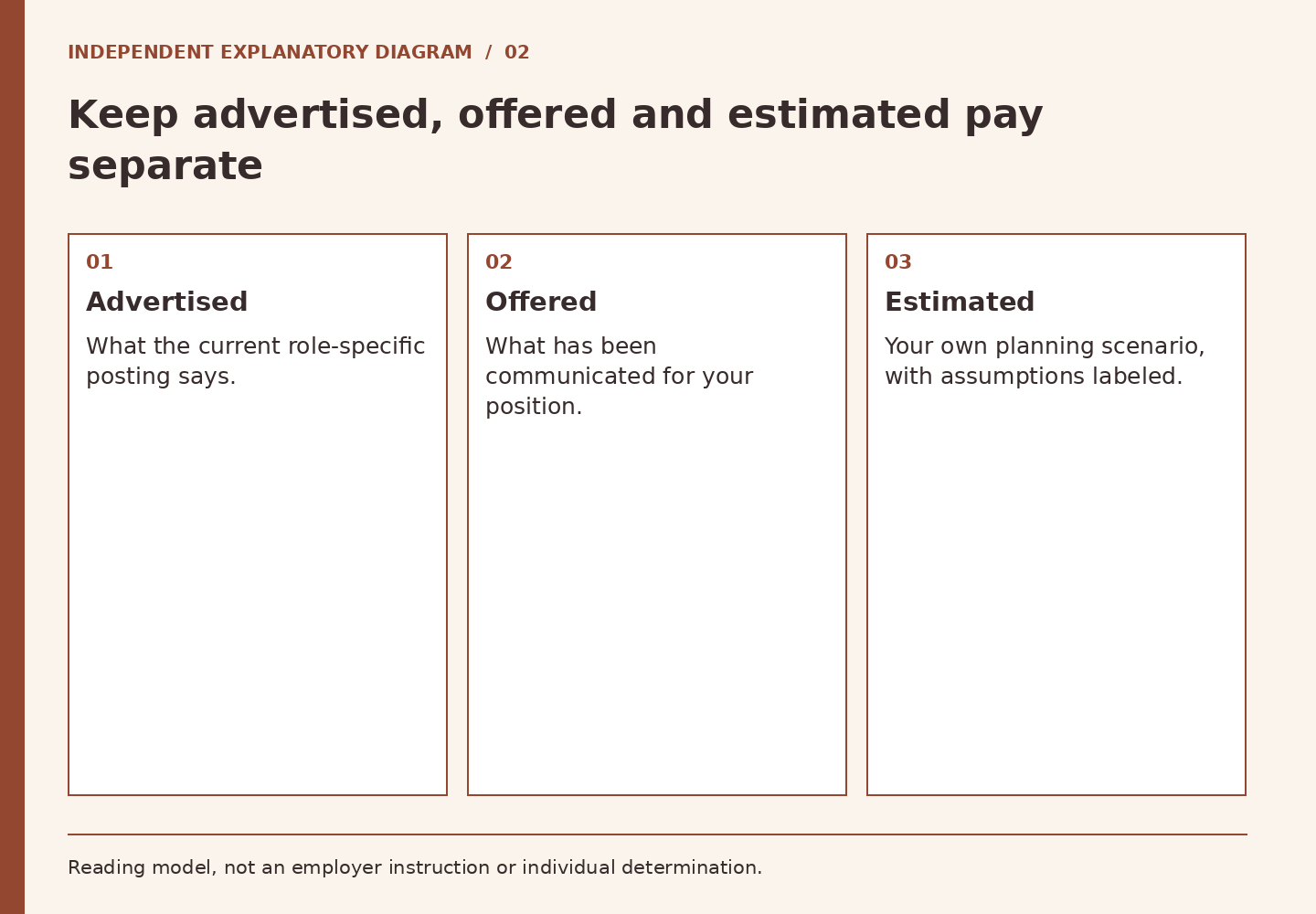
An advertised number is evidence of what the posting says. An offered number is what the employer has specifically communicated for your position. A planning number is your own assumption for organizing expenses. Label these separately even if, at first, they happen to be the same. The labels stop an estimate from becoming an apparent promise when you revisit the note later.
For hourly work, the rate alone does not establish total gross earnings. You also need the paid hours in the relevant period. For a salary, do not invent a pay-period conversion without confirming the actual pay frequency and first-period treatment. For variable pay, keep any expected commission or incentive separate until you understand how it is earned and when it appears in payroll.
A useful planning note might say, “This scenario uses the offered rate and an illustrative number of hours; those hours have not been guaranteed.” That is more honest than a precise-looking monthly total assembled from an optimistic schedule. If a decision only works under the optimistic scenario, the uncertainty deserves attention before you rely on it.
Build the first-month timeline before the arithmetic
Write down the proposed start date, the work period a first payment would cover, the expected payday supplied by payroll, and the dates of unavoidable expenses. Leave unavailable dates blank and ask the employer. A payment can cover a shorter initial period than a later normal payment; this is a possibility to clarify, not a claim about Nordstrom’s payroll calendar.
Consider a fictional applicant who expects a first paycheck soon after starting. The employer explains that the first scheduled payday includes only a small portion of their initial work because of the actual pay-period boundaries. The hourly rate was never the disputed fact. The budget problem came from assuming a payment period. The useful correction is to confirm the calendar before committing to expenses against an imagined full payment.
Gross earnings do not predict every deduction
The IRS withholding overview distinguishes income-tax withholding from Social Security and Medicare taxes. Other paycheck items may have their own basis. Applying a single percentage learned from a coworker is not a dependable way to predict your net pay. Their earnings, elections, tax circumstances or work location may differ.
When you have current records and need a federal withholding estimate, the IRS Tax Withholding Estimator is an official resource to assess for suitability. Read its instructions and limits. This publication does not calculate taxes, recommend a withholding election or request your financial information. A payroll explanation can identify a line on a statement; personalized tax advice is a separate service.
Treat the first statement as a calibration point
Once the actual first statement arrives, compare it with the planning note. Did it cover the dates you expected? Did it use the communicated rate? Are the earnings categories recognizable? Which deductions began, and which have not appeared? Revise your future estimate using the answers rather than multiplying an unusual first payment into a full year.
Do not quietly revise an apparent error out of the record. If the stated rate or included hours do not match your understanding, preserve the original statement and ask a specific question through the employer’s verified process. Keep an estimate labeled as an estimate, a correction labeled as a correction, and the original record intact. The first-pay review gives a structured way to perform that check without turning a budget exercise into an unsupported wage or tax determination.
Sources and reading boundaries
Sources checked October 7, 2026. This is a review date, not a policy effective date or an account test.
- Nordstrom Careers: public career and job listings: Employer context includes stores, corporate, supply chain and restaurant/specialty-coffee work, with some advertised commission-sales roles. No wage range, headcount or job availability is promised. Review basis: Official public page opened and reviewed.
- IRS: Tax withholding: General distinction among federal income-tax withholding and Social Security/Medicare taxes; no personal withholding calculation. Review basis: Official source text reviewed through search-index retrieval.
- IRS: Tax Withholding Estimator: Official federal withholding-estimate resource; preparation requires current information and its own eligibility guidance. No endorsement of a specific election. Review basis: Official source text reviewed through search-index retrieval.