A health-plan summary may contain a neat example showing how a plan shares the cost of a particular kind of care. The example is useful precisely because it simplifies a complicated process. That simplicity also creates a risk: a reader may treat the displayed amount as a quote for their own treatment, a promise about a provider or a complete annual budget.
For a Nordstrom worker reviewing actual enrollment materials, the useful task is to compare the options the employer has made available to that person. This publication has not inspected those private options. It does not name a preferred plan, estimate a medical bill or recommend treatment. The article is about reading a standardized example carefully.
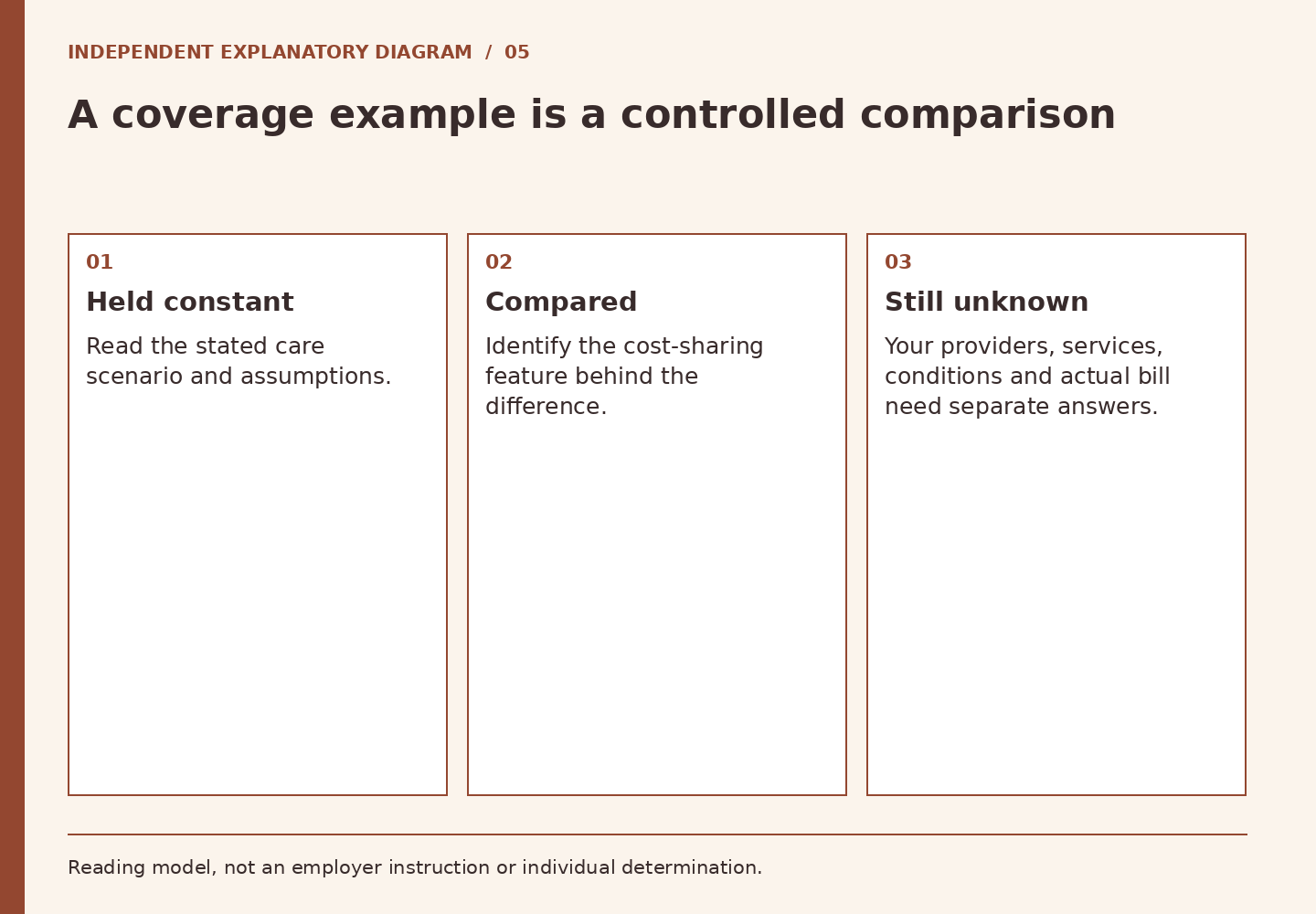
Identify what the example holds constant
The CMS explanation of Summary of Benefits and Coverage materials describes simulated coverage examples used to make plan information more comparable. They are controlled illustrations. The care scenario and assumptions help expose differences in how plans share costs; they do not reproduce every fact of a reader’s circumstances.
Start by reading the example’s own notes and assumptions. What service scenario is being illustrated? What coverage period and plan version apply? Which expenses appear in the example, and which are outside it? If you cannot identify those boundaries, do not use the headline result as a personal estimate. Ask the plan’s verified assistance route for the document or explanation you need.
Compare like with like, then return to the actual question
Use the same standardized scenario across the actual options available for the same period. Note which cost-sharing feature seems to drive a difference. Is the distinction related to a deductible, a copayment, coinsurance or another term shown in the summary? The example can direct attention to a provision worth reading, even when it cannot predict what you will spend.
Now put the example away and write your real question without including medical details in a public tool. It might concern access to a particular provider network, the treatment of a service category, or the financial exposure described by the plan. An illustration that looks favorable on paper cannot answer a different question it was not designed to model.
Keep three cost ideas in their own columns
The CMS terminology guide distinguishes the premium, deductible and out-of-pocket limit. It also explains that an out-of-pocket limit excludes premiums, balance-billed charges and uncovered care. Those boundaries matter when someone tries to turn one large-looking limit into an all-inclusive ceiling.
In a private comparison, keep the cost of having coverage separate from cost-sharing when using covered services and from expenses outside the stated protections. Use the actual documents for how the definitions apply. Do not simply add a deductible to an out-of-pocket limit, since the relationship between those figures needs to be read rather than guessed. Do not infer that a low premium is the lowest total cost in every scenario.
A fictional example of a misleading shortcut
Two fictional plan summaries show different results for the same sample care scenario. A worker concludes that the lower displayed result guarantees lower costs for a planned procedure. Before acting, the worker notices that the comparison says nothing about the exact facility or the worker’s specific service arrangement. The conclusion had outrun the example.
The useful next step is to ask the actual plan about the relevant coverage terms and network, then ask the appropriate provider or plan process about any available estimate. Keep the limits of an estimate visible as well. A confirmation about network participation does not necessarily settle every coverage, authorization or billing question associated with a service.
Preserve the reasoning behind an election
You do not need to keep a medical diary to document a comparison. Save the dated summaries and a brief private note of the factors you considered, the official answers you received and any remaining uncertainty. The DOL plan-information resource is background on the documents available for covered plans; it is not a substitute for the particular terms.
If an actual claim is later denied, a comparison note is not itself an appeal. Read the distinction between a routine question and a formal claim and follow the current notice promptly. The right result from this article is a more disciplined use of an example, not a simulated bill presented as a promise.
Sources and reading boundaries
Sources checked October 7, 2026. This is a review date, not a policy effective date or an account test.
- CMS: Summary of Benefits and Coverage and Uniform Glossary: Standardized coverage summaries, common terminology and simulated coverage examples help comparisons. Examples are not personal quotes. Review basis: Official source text reviewed through search-index retrieval.
- CMS: Health insurance terms you should know: Definitions of premium, deductible and out-of-pocket limit; the limit excludes premiums, balance billing and uncovered care. Review basis: Official source text reviewed through search-index retrieval.
- U.S. Department of Labor: Plan Information: General ERISA plan disclosure roles, including SPD, modifications and SBC. Not a ruling about a particular program or individual. Review basis: Official public page opened and reviewed.