Moving to a new role inside the same company can feel administratively simpler than changing employers. Familiar systems and colleagues may remain. Yet a move can create new questions about compensation, work expectations, location, benefit eligibility and the timing of changes. The familiar company name is not evidence that every prior term carries forward unchanged.
Nordstrom’s career site describes several kinds of work, and its benefits page notes eligibility variation by role, hours and location. Neither page determines what an individual transfer changes. This article supplies an original before-and-after review for the employee’s actual change notice and subsequent records, not a company transfer policy.
Establish the baseline you are comparing
Before evaluating a change, identify the current arrangement from records you already have permission to use. Note the current role, work location, compensation description and relevant effective date. Keep a recent routine pay statement and current confirmations for the benefits that matter to the change. You are documenting a baseline, not collecting every internal file connected to the old job.
Next identify the new arrangement in the written communication. Which facts are stated? Which remain assumptions? A new title might be explicit while the work location, variable-pay treatment or benefits impact needs a separate answer. If an important point is discussed verbally, record the question and ask where the applicable terms are documented.
Do not collapse every date into the start date
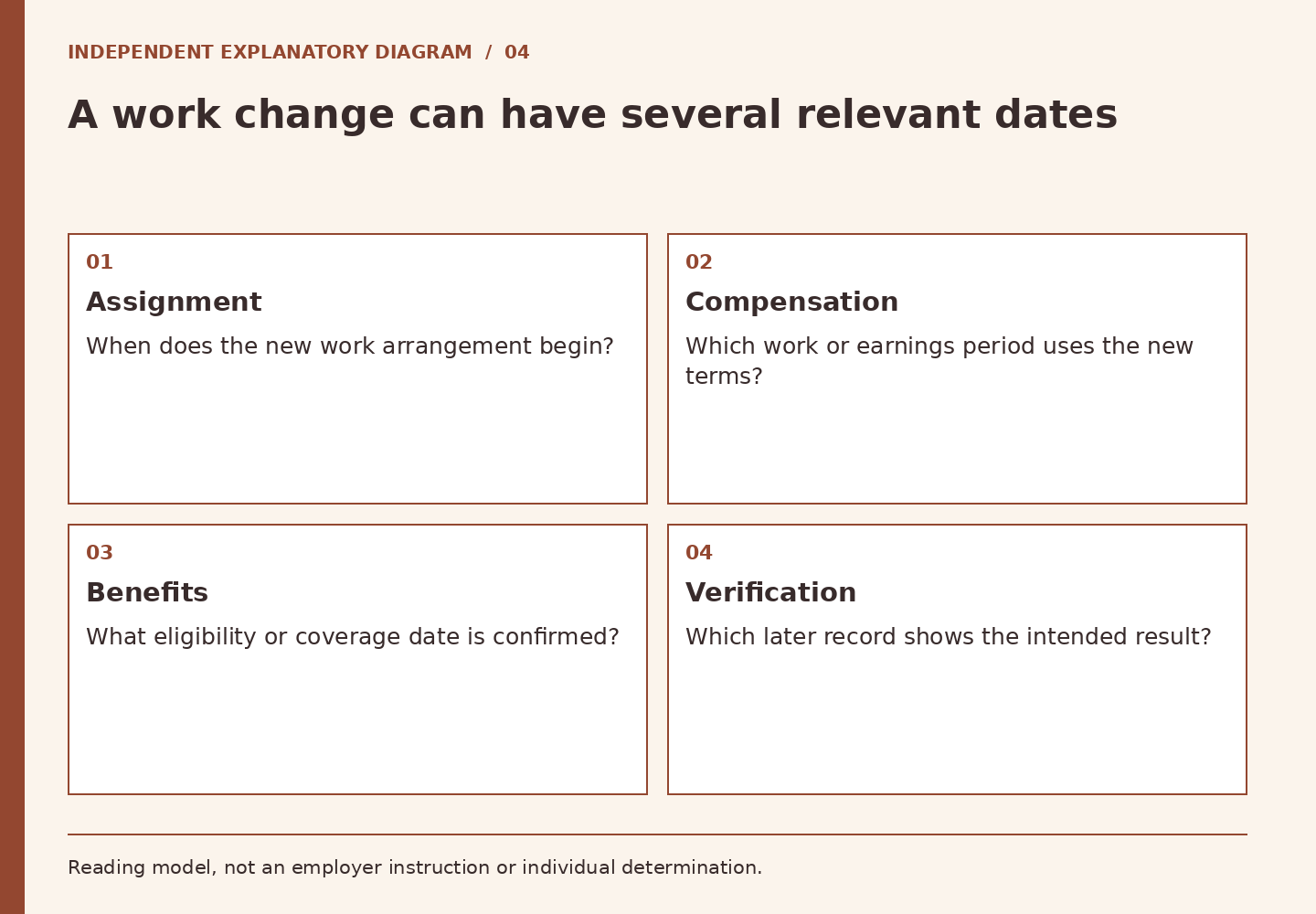
A work assignment can begin on one date while a payroll change, eligibility review or coverage change has its own effective date. This is a question to investigate in the real arrangement, not a claim that these dates always differ. Label each date with the event it belongs to. “Effective next month” is incomplete until you know what becomes effective.
Consider a fictional employee moving from one type of retail work to another. The employee receives a role-change notice and later sees an unfamiliar earnings line. The useful comparison is the new compensation description against the period on that statement. A benefits question raised at the same time should be checked against its own confirmation. One accurate record does not prove the other record has been updated.
Follow the consequences of one changed input
If the work location changes, ask which location the employer is using for relevant employment and benefit purposes and whether any employee action is required. If expected hours change, ask which records and review process determine any effect on eligibility. If the compensation arrangement changes, ask how work or transactions spanning the change date are treated. Leave the legal and plan-specific answers to the responsible source.
Keep these questions bounded. You do not need to send private health information to explain that you want continuity information. You can ask which benefit confirmations should be reviewed without asking a manager to interpret medical coverage. A precise question reduces the amount of personal information that must move between teams.
Read changes as changes
The DOL plan-information page explains that changes to an ERISA-covered plan may be communicated through revised descriptions or a summary of material modifications. When a plan change is involved, the useful task is to identify the affected provision and effective period, not merely to save another document with the word “benefits” in its title.
A change notice can answer a different question from a personnel notice. One may describe a plan-wide rule; another may describe your new work arrangement. Do not treat a plan-wide announcement as proof of your personal enrollment, or a role-change notice as a complete description of the plan. Keep each with the specific issue it supports.
Verify what actually followed
After the move, compare the first relevant pay statement with the confirmed compensation terms. Check any required election or confirmation independently. If a result differs, ask about that specific period and input rather than sending a broad message saying the transfer “did not go through.” Keep the original notice and any corrected explanation together.
A completed review should show what changed, when each change applied and which results remain unconfirmed. If the change is accompanied by marriage, loss of other coverage or another personal event, use the separate life-event timing guide; those facts should not disappear inside the personnel update. This publication cannot decide eligibility or certify a transfer’s completion, but it can help you avoid assuming that one administrative action settled every related question.
Sources and reading boundaries
Sources checked October 7, 2026. This is a review date, not a policy effective date or an account test.
- Nordstrom Careers: public career and job listings: Employer context includes stores, corporate, supply chain and restaurant/specialty-coffee work, with some advertised commission-sales roles. No wage range, headcount or job availability is promised. Review basis: Official public page opened and reviewed.
- Nordstrom Careers: Benefits: Public program categories and explicit role, hours and location eligibility qualification; no personal entitlement or unpublished rate is verified. No authenticated benefits account, plan document or individual enrollment was inspected. Review basis: Official public page opened and reviewed.
- U.S. Department of Labor: Plan Information: General ERISA plan disclosure roles, including SPD, modifications and SBC. Not a ruling about a particular program or individual. Review basis: Official public page opened and reviewed.